



Satoshi Nakagawa Selections
-
On Sale

-
On Sale
-
On Sale

-
On Sale

-
On Sale
-
On Sale

-
On Sale
-
On Sale
-
On Sale

-
On Sale

-
On Sale

-
On Sale

-
-
On Sale

-
On Sale

-
On Sale
-
On Sale

-
On Sale
-
On Sale

-
On Sale

-
On Sale
-
On Sale

-
On Sale
-
On Sale

-
On Sale

-
On Sale
-
On Sale

-
On Sale

-
On Sale

-
On Sale

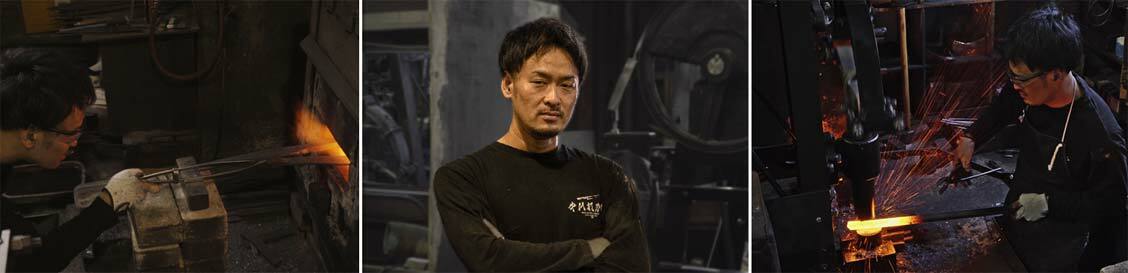
Satoshi Nakagawa — A Young Traditional Blacksmith from Sakai
Satoshi Nakagawa is a young blacksmith working in Sakai City, Osaka Prefecture, the mecca of Japanese kitchen knives. Sakai is a city of cutlery unlike any other in the world, having forged knives for chefs for over 600 years.
At just 18 years old, Mr. Nakagawa began his apprenticeship as the sole disciple of the legendary traditional blacksmith Kenichi Shiraki. For the next 16 years, he honed his skills at the same forge. During the latter half of his apprenticeship, due to his master’s poor health, he effectively ran the workshop and is said to have taken personal responsibility for every single knife that left the workshop.
In 2021, he struck out on his own and opened his own workshop, “Nakagawa Uchihamono,” in Sakai City. In 2023, he became the youngest person in the long history of Sakai cutlery to be certified as a “Master of Traditional Crafts.”
| Blacksmith | Satoshi Nakagawa |
|---|---|
| Workshop | Nakagawa Uchihamono (Established in 2021) |
| Location | Sakai City, Osaka Prefecture |
| Master | Kenichi Shiraki — A master craftsman representing Sakai’s traditional Honyaki style |
| Apprenticeship Period | 16 years as Mr. Shiraki’s sole apprentice |
| Title | Master of Traditional Crafts — Certified as the youngest person in the history of Sakai-style forged blades (2023) |
| Specialty | Mizu-honyaki on Shirogami No. 1 steel, three-layer construction, and hand-forged hamon |
| Representative Works | “Sakachoji” Mizu-honnyaki — A blade pattern uniquely created by Mr. Nakagawa |
Three Reasons Why Chefs and Collectors Worldwide Seek Out Satoshi Nakagawa’s Knives
There are three main reasons why Mr. Nakagawa’s knives stand apart from those of typical Sakai blacksmiths. These are also the reasons why chefs in New York and Los Angeles are willing to wait years just to get their hands on one.
① “Mizu-honyaki” made from Hakushi No. 1 steel — a technique said to be mastered by only a few blacksmiths in the world
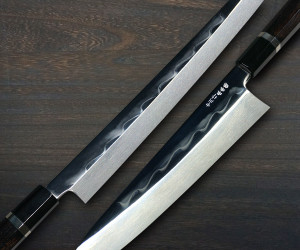
“Honyaki” refers to a knife forged from a single piece of high-carbon steel, where the blade is hardened by applying clay in specific areas during quenching, while the spine is left with a resilient texture. This forging technique, which shares the same lineage as Japanese swords, produces a beautiful hamon (temper line) at the boundary between the blade and the spine.
Among these, “Mizu-honyaki” is a highly challenging quenching method requiring the most delicate temperature control; even the slightest mistake can ruin the entire knife. While the general success rate is said to be around 30%, Mr. Nakagawa is said to maintain a success rate of approximately 90% for the most difficult Mizu-honyaki on White No. 1 steel — according to some specialized news articles.
It is believed that there are only a few blacksmiths in the world capable of forging Mizu-honyaki on Hakushi No. 1 steel into functional kitchen knives.
② “Saka-chōji” Hamon — A Pattern Developed Exclusively by Mr. Nakagawa
Drawing on the vocabulary of traditional Sakai hamon, Mr. Nakagawa created his own unique pattern, the “Saka-chōji / reverse chōji hamon.” This pattern, which reverses the direction of the classical “Chōji” hamon, possesses a calligraphic fluidity never before seen in Sakai Honyaki.
Honyaki featuring the “Saka-chōji” is produced in only very limited quantities each year; while serving as practical cutting tools, they are also highly valued as collector’s items.
③ Preserving the Essence of Sakai While Embracing Modern Steels
While inheriting the rigorous fit, finish, and edge preparation passed down from Mr. Shiraki, Mr. Nakagawa is actively experimenting with modern stainless steels such as VG10 and Gin-san.
This choice is made with an eye toward use in households and professional kitchens outside Japan — particularly in the humid climate area — and embodies a design philosophy of “preserving Sakai’s DNA while adding ease of use.”